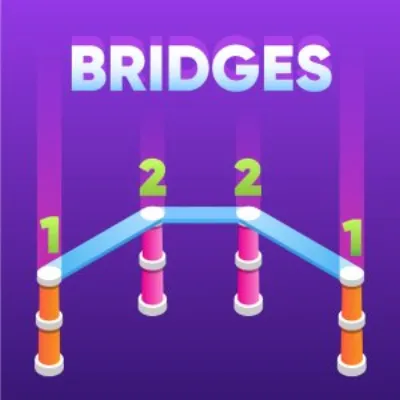
In standard Hashi, each island needs the number of bridges printed on it, and every island must belong to one connected network. Matching the numbers alone is not enough.
Count capacity before adding a bridge
Bridges run horizontally or vertically to a visible neighboring island, do not cross, and have a maximum of two between a pair. Suppose an island still needs three bridges and has only two possible neighbors. If one direction can take at most one more bridge, the other must take two and the first must take one. Recalculate capacity when another bridge blocks a route or a neighboring island reaches its total.
Try the steps
- Subtract existing bridges from each island's clue and list the remaining legal directions.
- Fill a direction only when the counts or network requirement force it; check both ends.
- Before closing a group, verify that at least one connection can still reach the other islands.
Can two islands numbered one simply connect to each other?
Not if doing so finishes an isolated pair while other islands remain elsewhere. Their individual counts would be correct but the single-network rule would fail. Work from both local totals and global connectivity; a visually complete corner is not necessarily a valid part of the final solution.